The History of looking forward to the emergence
To look forward to a savior goes back to the last years and even centuries. Of the 150 sections of the book of Psalms of David [pbuh], which belongs to 2800 years ago, 55 sections are related to Imām Zamān [mgehr].
It is stated in Psalm 149 of that book, “He will rise, holding a double-edged sword.” (It refers to Ḏū-l-Faqār[1].)
The look forward -To the Emergence
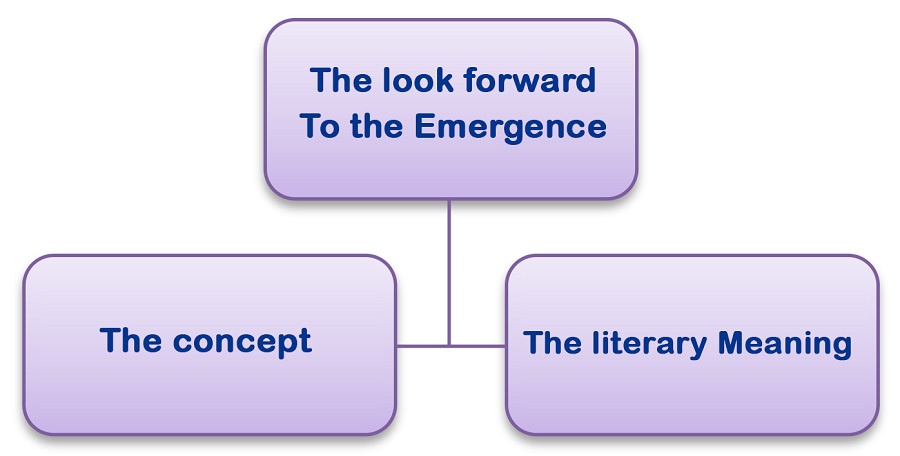
The literary Meaning:
Pause about things and then decide, to watch, to look forward to, a kind of hope for the future.
The concept:
Referring to the Aḥādīth, to look forward to [the emergence] is a deed, worship, and jihād[2]. But unfortunately, some people limit it to the literary meaning.
Given the two above interpretations, two types of perceptions are expected:
1. A kind of looking forward in which, the one who looks forward endures the current situation and remains still, having hope for a better future.
2. A kind of looking forward that brings dynamics and activity.
It should be noted that that kind of looking forward (the second one) never has meant and means to protest ( the current situation), or to avoid (to step back). For the one who looks forward, protesting is admirable when it causes attempts and effort. Otherwise, that person is like the one who is oppressed, but he is not aware of it.
To fulfill the Emergence, we should look forward [to it]; hence, we must know what we are looking forward to. In Holy Qurʾān, God stated,
” فَانْتَظِرُوا إِنِّي مَعَكُمْ مِنَ الْمُنْتَظِرِينَ”
“Wait and I too shall be waiting with you”.[Surah Yunus, Verse 20]
Grounding
[Once] someone entered the presence of Imām Baqīr (PBUH) and said, “Verily, If Mahdī (MGEHR) rises, everything will proceed and goes well for him on its own. And there will not shed blood, even as much as a cupping container.” His Majesty returned, “It is never like this, By the one who owns my life, if it was supposed that things go right for someone on its own, surely, it had been for the Messenger of God (pbuh&h), when His Majesty’s anterior teeth were broken and his face wounded. It is never like this, By the one who owns my life, it will lead you and us to wipe away dried blood and swear.” (Bihar al-Anwar, Volume 5, Page 358)
Know that the next step after looking forward to the Emergence and acting to lay the groundwork is that we are to welcome The Excellency (mgehr).
From Ādam (PBUH) to the Emergence
It has been extracted from the Aḥādīth that, to reach the Emergence, the human has to pass six stages, before the seventh which is the Emergence.
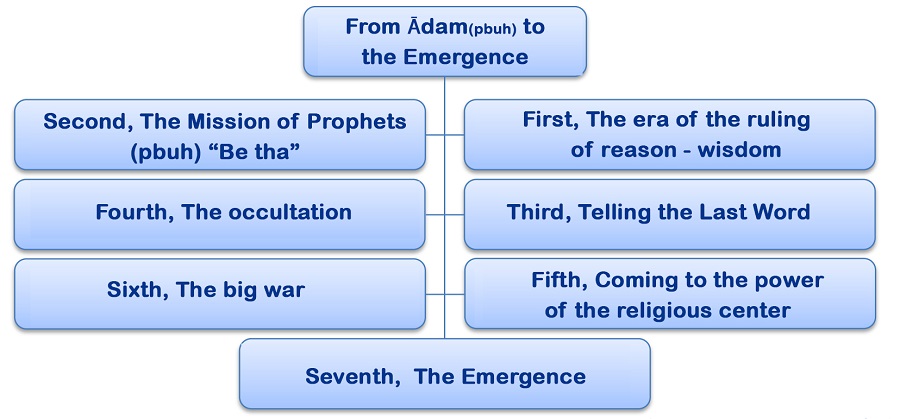
First, The era of the ruling of wisdom
That stage is the era of the ruling of reason. It started His Majesty Ādam (PBUH) until His Majesty Noah (PBUH). At this stage, the humans lived merely relying on their innate intelligence and there was no universal call to guide humanity. In this stage of invitation by prophets (PBU THt), acting according to the human’s wisdom and conscience.
Second, The mission of prophets (PBUH)
That stage is for the Mission of Prophets (PBUH), which started by His Majesty Noah (PBUH) and ended by the Last Prophet (pbuh&h) in “Ghadir Khumm3”. On Ghadir day, It is worth mentioning that the Prophet (pbuh&h) stated, “This day I have perfected your religion for you and completed My favor to you.” (Holy Qurʾān, surah Al-Maeda, verse 3)
Through that stage, when the human realized wisdom, the religious laws came to help it.
Third, Telling the Last Word:
This stage is the Last Word. It started by ‘Amir a- Muʾminīn (PBUH) and continued till the minor occultation of Imām Zamān (mgehr). In this stage, the order of reason and the religious law were combined by the Imām, and it was proved that they don’t contradict each other.
Fourth is occultation:
In this stage, the religious law didn’t accompany wisdom anymore. In fact, the human connoted, “Wisdom is enough for me!” [However,] the human goes so far as to prove to him that reason alone is not enough to guide human society! Well, in today’s world there are one billion and eight hundred million hungry people, and this is just one of the thousands of cases of human stupidity.
Fifth is coming to power of the religious centers:
The starting point of this stage was the Islāmic Revolution of Iran. In this stage, the religious centers all around the world began to take shape, then they cross paths to form a network and a [global religious] village. In this stage, the people will realize what is expected to request from The Savior [Imām Zamān (mgehr)].
Sixth, the Great War:
Huntington predicted that civilizations would collide in the future
And it is the approach of Prohet Muhammad (PBUH) that wins
He achieved world fame with the theory of the clash of civilizations and the prediction of the conflict between the Western world and the Islamic world.
Dr. Samuel Huntington was a scholar and, for 58 years, a professor at Harvard University.
Seventh, emergence of the savior: In this stage, humanity, due to the prolonged wait, comes to appreciate the value of their savior.
Responsibilities of the Awaiters: In the book Mekyal al-Makarim, 80 duties for the Awaiters are identified. Six of them are mentioned here:
- Prayer:
- Praying for the health of Imam Mahdi: Like other Imams, Imam Mahdi can also fall ill. It is mentioned in history that Imam Ali (peace be upon him) suffered from eye pain, and the Prophet healed him (Bihar al-Anwar, Vol. 39, p. 12).
- Praying to renew covenants and promises: God took three covenants from humanity: innate, rational, and Sharia-based. The Sharia-based covenant is described as dedicating one’s life, wealth, children, family, and everything God has granted to His path (Bihar al-Anwar, Vol. 102, p. 118). A supplication of covenant from Imam Sadiq (peace be upon him) includes renewing allegiance with Imam Mahdi.
- Praying for Imam Mahdi’s reappearance: Imam Sadiq (peace be upon him) addressed Imam Mahdi, saying: “O my leader! Your absence has deprived me of sleep, constrained the earth for me, and taken away my heart’s peace” (Kamal al-Din wa Tamam al-Ne’ma, Sheikh Saduq, Vol. 2, p. 31).
- Praying to be among his companions: Imam Sadiq (peace be upon him) said, “We have three rights over you: that you recognize our virtues, follow us, and await our reappearance” (Usul al-Kafi, Kulayni, Vol. 2, p. 173).
Knowledge and awareness
The one who dies without knowing the Imam of his time has died a death of ignorance. [Kamāl al-Dīn, Vol. 2, P. 410]
Imam Hussain (pbuh), “… Allah does not accept any acts from His servants except through the knowledge of us.” [Al-Kāfī, Vol. 1, P. 143]
Affection
Increasing knowledge brings love. Affection causes heart attraction, and people who consider his holiness [Imām Mahdī (mgehr)] as their beloved should be similar to him, in terms of behavior and deeds. Imam Bāqir (as) said to Jābir:
O Jābir! Is it enough for someone who claims to be a Shia if only they assert their affection to us “[of the Prophet (pbuh)’s Ahl al Bayt]? I swear by God, they are not our Shia, except those who fear God and obeys Him. O Jābir! They [Our Shia] will not be recognized except through humility, humbleness, trustworthiness, remembering God very much, fasting, prayer, kindness to parents, caring for poor neighbors, helping the debtors, caressing the orphans, being honest, reciting the Qur’an, saying good things about people, and being honest and trustworthy in everything for their friends… Is it enough for someone to say, ‘I love Ali and consider him as my guardian, but yet they are not diligent in affairs and action? Therefore, fear the punishment of God, and work to achieve what is with God; God has no relatives!
====
1. The sword of Imām Alī (PBUH)
2. In an Isāmic context, it can refer to almost any effort to make personal and social life conform with God’s guidance, such as the struggle against one’s evil inclinations.
3- It refers to a sermon delivered by the Islāmic prophet Muḥammad (pbuh&h) at the Pond of Khumm, shortly before his death in 632 CE. In the sermon, Muḥammad (pbuh&h) announced Ali ibn Abi Talib (PBUH) as his successor, after which the final verse of the Quran has revealed a verse of the Qur’an was revealed instructing Muḥammad (pbuh&h) to deliver an important message. The Muslīms were gathered and Muḥammad (pbuh&h) delivered a lengthy sermon.
Leave a Reply
You must be logged in to post a comment.